Saturday, 3 September 2016

The Anonymous Q7 Identified.

Comments in another place about the Q7 featured in this blog were a little premature. The results of the painting and weathering are here to see, in a pose trying to replicate history.

(We have moved these photos from the end of the previous posting).


The top picture is of a product of Darlington Works, the bottom one a Dave Alexander kit.

Thursday, 25 August 2016

A Long Overdue Update! 

A lot of the progress with South Pelaw since our last posting here has been unseen but nonetheless dramatic.
We had a problem with our turnout operating system. We adopted an Iain Rice method favoured by some P4 modellers of having the point tie-bar under the baseboard with droppers from the switch blade toes, all made to look realistic with cosmetic tie bars above the baseboard. This meant making our own point machines utilising servos. The outcome was disappointingly unreliable so we went back to old fashioned PCB tie bars. This involved a lot of work in retro fitting the tie bars and motors, about 40 in all. The servo mounts are MERG 3D printed.

The other major trauma was the decision to abandon the installation of DC cab control and go for DCC. The ripping out of lots of wire and relays was quite painless and the rewiring with heavier duty wire has gone smoothly. Nonetheless it has taken time. Whilst the fiddle yard track plan had been decided many moons ago we never had a clear mind about how it would be controlled. This indecision with several daunting alternatives was partly instrumental in changing to DCC. As a result the fiddle yard track and pointwork is complete and the wiring is about 50% complete.

The front side of the layout works pretty well but it has meant that the scenic work has been slowed down whilst baseboards have been upturned for rewiring. However two of the baseboards are now scenically complete but are erected with the next one for continuity of treatment in one of our crew’s garage. Now for the first time in many months we have been able to erect 8 of the 11 scenic boards as a unit. Another ‘behind the scenes’ activity has produced the LED lighting system. All this was squeezed into the room we use for construction. We were rather in each others way.
We have made a number of signals including the Stella Gill Flatts gantry. We have completed the lengthy painstaking building of one set of cottages. Two of the three bridges are now complete and fastened in place whilst the third has taken significant strides forward recently.

We have been running our version of the MICs by passing on various model making skills within the group. The building of the NCB shed is part of this process as is the building of signals.

We have also progressed the building, modifying or finishing off of locos and rolling stock. We have fitted DCC decoders to some. Others to follow.

The following photos show some of the progress.
What it's all about - Iron ore to Consett and coke backing out of Stella Gill ready to follow up the bank - with assistance of course.

Talking of assistance, a Class 40 in the 'shove' mode. This is a Modern Outlines kit built brass loco. It doesn't need a sound decoder - it makes enough noise as it is.

A remarkably clean loco - not unlike 'The Tyne Docker' final steam hauled train.

An interesting oddment of rolling stock in the Stella Gill reception sidings.

A view from across the tracks.

A similar view just a few months later.  What the express passenger headcode is about, I don't know!

And another 24 to the rescue!

The box that controlled that gantry. Long gone of course but the bridge remains, filled in underneath and surrounded by trees and undergrowth. We think it survives because it still carries the pipeline (water or gas? We know not).

A bit of truth stretching here. There was a turntable at Stella Gill, two in fact, but we have put this in a location that is not really accurate. The passenger train is reasonably accurate but running late - by a few years!

The first set of cottages has been finished but has yet to be fixed in place in the gardens. The adjacent structure is a balsa wood mock up representing the other terrace of cottages. It needs to be recessed into a lower ground level


These two photos show the cottages before the gardens have taken seed. Close examination  of the upper phot shows the two bridge plates - nos 2 and 27. The scenic work in this area is the basic first cover before the detailed treatment.                                                            


A closer look at the Pelton Lane bridge with the Class 40 banker just going underneath. As mentioned above, this bridge has two bridge plates. The tracks nearest are passed over by bridge no 2 (from Ouston Junction), whereas the other side is bridge 27 over the branch which comes via Washington. (Part of the original Stanhope & Tyne).

This is where bridge 2 and 26 cross the tracks. It's a bit like this today, no bridge but no tracks either, just a cycle way.

This is still a work in progress. It has taken a long time to work out how to make the wrought iron parapet panels. They have a rolled over top edge. One panel is at the far end.

The same panel moved to the other end for the cameras. It gives us the opportunity to show another signal. A relatively modern replacement for a slotted wooden post which was sited at the other side of this bridge, consequently even taller.

You've seen these signals before but the signal box has a new roof, still being finished. Work on this model was halted to divert effort into the completion of the Pelton Lane bridge which needed to be in place first. The signals have yet to be fixed in place. They have been in and out several times to take them to the MERG stand at exhibitions.

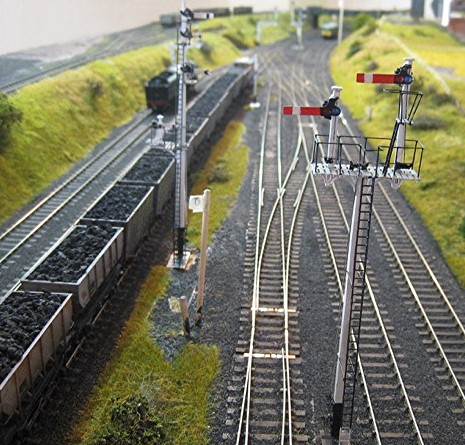
Two more recently completed signals. The real ones were removed in the sixties and replaced by tubular posts. The nearest one became a colour light signal in a different location. It controls the entry to the junction whereas the far one controls the entry to the line towards Tyne Dock.


A view from bridge 1/28. The replacement tiebars in the point work are visible. they need to be painted and disguised.

Another view showing the down branch starter, below it a subsidiary signal for allowing a loco to pass the signal at danger to reverse across to the up line and the distant signal for the next box in the down direction (Biddick Lane, I think). All these are modern replacement upper quadrant arms on the existing, originally slotted. post. On the little bracket is a lower quadrant slotted post shunting signal for locos traversing the crossover in the opposite direction. Not the easiest signals tackled.

A lovely slotted post shunting signal controlling the exit from the Up sidings. The 9F is not a Western region one despite the brass chimney. It's a Bachmann in the process of conversion!

There are two even smaller signals that have been modelled, NER pattern rotating lamp ground signals. Unfortunately they don't show up well on any of our current photos. That will be attended to. They will have a dozen more for company but of the LNER rotating disc type - eventually.

An unashamed look at the gantry at the other end of the layout. By this stage in its life all the arms were shunting ones. The yard beyond had 38 roads in its heyday!

Eight of the 13 arms on the model do work, from servos. We don't have enough roads in our fiddle yard to justify the extra complications. All of the other signals on the layout work (or will do) from servos driven by the MERG CBUS system.

We must apologise for some of the photos showing locos that have passed signals at danger. Once the layout is up and running properly, such offences will be punished. The penalty will be 'drinks all round' for the rest of the crew.

Hope you enjoyed this trip.

We'll try to update things more often.


Tuesday, 20 October 2015


It's Been A While 

With not having a permanent home big enough to erect it, the base boards of our South Pelaw layout have been scattered for some time. However last month we collected everything together and erected it in a hall in Middlesbrough - by the kindness of the Middlesbrough Model Railway Club.

The event enabled us to take stock of how far we have progressed and to remind ourselves how far we have yet to go. We also established that the layout will fit comfortably into a Transit Luton van, thus keeping expenses down when we take it to exhibitions. (Don't ask when!)

The first photo gives you some idea of the size of the layout. It's 39 ft x 18 ft. Unfortunately Richard's delightful pointwork at the approach to the fiddle yard is about as far away from the camera as it could be.

And that's Pete, the Slim Controller.


The most visible development has been the work done by Phil to lay down the scenic details. He's mastered the static grass techniques. Phil used to live in the area and used to cross the line every day to go to school. Phil needs no motivation!

Here follows a few photos of an ore train that we managed to actually get running up the climb towards Consett.
  
This shot shows the tail end of the  ore train pulling up to wait for a banker. The lines in the foreground are those of the South Pelaw Colliery. The colliery isn't on the model.


Beyond the 9F can be seen two buffer stops. One of the very few things left in real life, the remains of these two NE cast stops are still there in the undergrowth (along with old tin cans and the like!)


 The banker has arrived, has buffered up and is ready for the big shove.

 
 The eagle eyed of you will spot that neither of the 9F locos are Tyne Dock ones. We were interested to see if the models would climb the gradient behind Stella Gill Flatts box - and they did with ease. Unlike the real things which had a hard slog. They are re-gauged proprietary models. New bodies and new tenders will turn them into realistic, reliable performers.


Inside Stella Gill Yard there were two turntables. After building the Stella Gill Flatts bridge, Richard is building one of them.  We have used a bit of licence as to the positioning of it. The 38 roads in Stella Gill yard are just too many for us to model so this end of the model departs from the prototype. Perhaps another day! 


A J21 waiting to be turned after the fire has been cleaned.


Here is the view from off Stella Gill Flatts bridge looking towards Pelton Lane bridge.


We can glance back and see Rich's model of Stell Gill Flatts bridge, At some time in the future there will be a signal gantry spanning the tracks. This governed the passage of trains into the extensive yard. Behind the box can be seen Phil's embryonic NCB shed. This building is also still in existence but in a very dilapidated state.


Running back down to pick up another seven 21 ton hoppers of coal, is this Q6 and van. They used to bring 21 hoppers as far as South Pelaw then split the rake into 3 lots of seven and then take each set up the bank in turn.


Mark's model of Pelton Lane bridge nearing completion. The wooden skewers indicate the positions of the many signals, yet to be built.


Pelton Lane Bridge from the other side.


And this is the view from off of Pelton Lane bridge with the last surviving N9 climbing the steep gradient to the colliery sidings.


This must be a Sunday shot with the ore train (still the wrong loco) running via Gateshead and Ouston Junction when the line via Washington was closed. It closed overnight weekdays and all day Sunday but if an ore ship was in Tyne Dock, trains often ran almost continuously, going the long way round if necessary
One new model signal that Rich has made and has been installed is the rotating lamp shunting signal on the far left hand of the picture.


Just looking back, later in the day we catch the back end of the oil train, banked by a Q6. Again the eagle eyed will spot that the oil tankers are not of the correct diagram. These are yet to be modelled - but you get the idea! A friend once said that the oil train was the one to nip away from work on a lunch time to go and take photos of. Two Q6s on full chat weren't to be intimidated by their 9F stablemates.


This is a shot taken a few months ago It shows Mark's Pelton Lane bridge before it was painted but shows an empty ore train heading back to Tyne Dock for another load. We understand that the train loco would do one round trip before returning to Tyne Dock  for servicing and to be taken over by a fresh crew. However the banker (in this case a Q7 sat in the siding) would do three round trips before heading back to Tyne Dock.


Now the view towards what we call Pete's bridge (because he's building it). The line to Ouston Junction goes off under the left hand span and the line from Tyne Dock via Washington comes in under the right hand span. This bridge was still in place when we started surveying for the model.  We photographed and measured it thoroughly. A good job because it was demolished a couple of years ago. Pelton Lane bridge was extensively re-built a few years ago, retaining the stone abutments but filling in all but a cycle way where the original steel span was. The bridge at Stella Gill is still in place but the track bed beneath has been filled in right up to the underside of the bridge. We think that the structure only survives because it supports a gas main, (visible on Rich's model).


This is what it looked like in stone rather than Plastikard!


Our depiction of things beyond the bridge show the line heading off to Ouston Junction on the left and, the line on the right somewhat unrealistically but supposedly climbing to cross the old A1 at Birtley (another bridge which is extant but no longer carries a railway) and thence via Washington on to Tyne Dock. The buffer stops are at the ends of the two sidings which went through the centre span of the bridge.


Looking back towards Pete's bridge we catch a WD, at the end of the working day, hauling the coal empties back towards Tyne Dock.


And a lucky photographer caught a view of the same train from across the fields.
A suitable shot to close our session.


Sorry It's taken so long to update this but with the boards scattered across the North, the photos we've taken from time to time, haven't done the layout justice. However this assembly session was arranged for a number of reasons, one of which was to take photos for this blog. There will be others .

Thanks for looking.

Richard, Rich, Pete, Phil, Mark, Martin and Joe.

Monday, 5 January 2015

Bridging the gap

Here are a few more photos of the layout, showing some of the recent scenic developments and especially the bridges. Although there is still a long way to go with the scenics (ground signals, point rodding, yard lamps, people, several large buildings ... etc.), we feel that we are beginning to capture some of the atmosphere of the place.

First of all a couple of posed (the loco is not under power) shots of a Q7 setting off up the bank to Consett with a train of suspiciously empty looking hoppers. The main development here is the abutments for the bridge, which are now nearly complete.


Another couple of posed shots show a WD waiting its turn to go up the bank, while a K1 waits in the banker's siding.


At the other end of the scenic section the bridge at Stella Gill Flatts is now almost completed. Now someone needs to start thinking about building the impressive gantry that stood here. John Donelly has some great pictures of this gantry as well as lots more information about South Pelaw and the Consett line on his blog describing a P4 version of South Pelaw set in a later time frame than ours --  http://southpelawjunction.co.uk/wp/?page_id=556.


Meanwhile, the hard work of wiring everything up and setting up the CBUS continues, although it is very exciting that most of it seems to work extremely well first time.


And behind the scenes, the fiddle yard is gradually turning from Templot into reality


Happy new year!

Richard Clayton